

Environment
Energy Management
Energy management policy and system
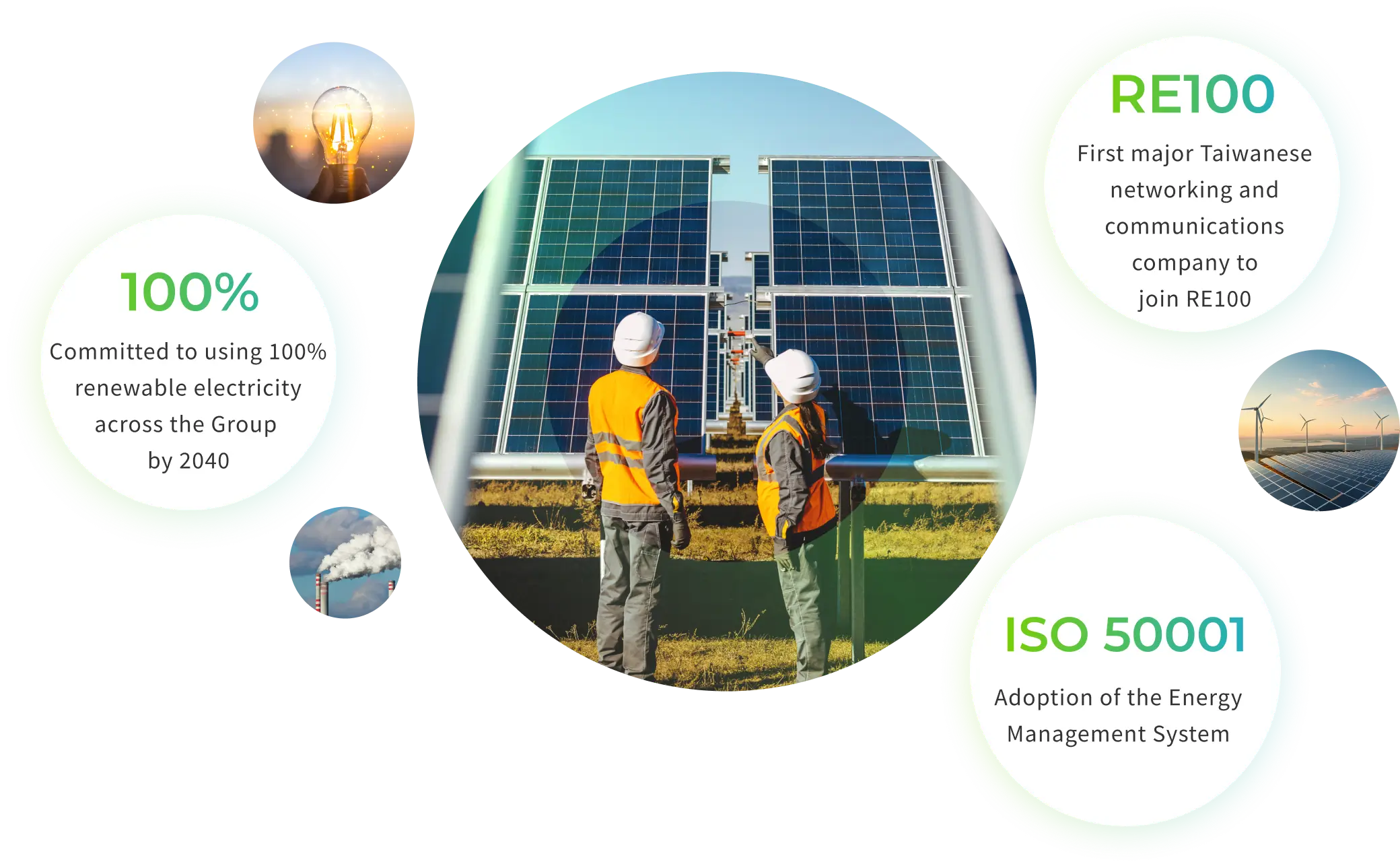
In 2023, WNC joined RE100, a global renewable energy initiative, and committed to using 100% renewable electricity across all of its sites by 2040, making it the first major Taiwanese network communications company to join RE100. WNC has also established an Energy Management Policy, implemented ISO 50001 standards, and regularly tracks the effectiveness of its measures in reducing energy use. As of 2025, WNC’s manufacturing sites in Taiwan, China, and Vietnam have obtained ISO 50001 certification. The company’s site in Mexico is in the process of implementing related systems and obtaining certification.
- 100% 承諾 2040 100% 使用再生能源
- RE100 台灣第一家加入 RE100 網通大廠
- ISO 50001 導入能源管理系統
Energy structure
WNC’s energy consumption consists of electricity and fossil fuels, including diesel, gasoline, and natural gas. In 2025, due to WNC’s global expansion, total energy consumption increased by 17.88% from 2024 to 153,978.92 MWh. Energy consumption intensity was 1,396.62 MWh per NT$ million of consolidated revenue. In the overall energy mix, purchased electricity was the primary source, accounting for 64.07% of total energy consumption. Fossil fuel use consisted of natural gas (1.44%), diesel (0.42%), and gasoline (0.18%). WNC’s efforts in low-carbon transformation has shown tangible results. Despite continued capacity expansion in 2025, the company’s non-renewable energy consumption decreased by 1.28% from 2024 to 102,361.28 MWh, representing 66.11% of total energy consumption. The remaining 33.89%, totaling 52,184.97 MWh, was derived from renewable energy.
Four-year Energy Consumption Statistics (MWh)
Four-year Electricity Consumption Statistics (MWh)
WNC is committed to optimizing its energy mix through a two-pronged strategy of installing solar power systems for self-consumption and purchasing renewable energy certificates. In 2025, WNC’s renewable energy usage accounted for 34.47% of its total energy consumption, marking a fivefold increase compared to 2022. Despite an increase in total electricity consumption driven by capacity expansion, WNC reduced its dependence on grid electricity, thereby laying a solid foundation for achieving its Scope 1 and Scope 2 net-zero targets.
| Electricity consumption statistics (MWh) | 2022 | 2023 | 2024 | 2025 |
|---|---|---|---|---|
Self-generated renewable energy for self-use (Self-generated solar power for self-use) | 952.12 | 5,320.04 | 5,039.89 | 8,684.97 |
| Non-renewable energy consumption (Diesel-generated electricity) | 1,559.19 | 817.00 | 1,089.04 | 567.32 |
Purchased renewable electricity consumption (I-REC) | 6,800.00 | 15,000.00 | 22,470.000 | 43,500.00 |
| Purchased non-renewable electricity | 109,001.23 | 105,000.90 | 101,250.64 | 98,661.88 |
| Total electricity consumption across all sites | 118,312.54 | 126,137.94 | 129,849.58 | 151,414.17 |
| RE Ratio (renewable energies use ratio) | 6.55% | 16.11% | 21.19% | 34.47% |
Note: Unit MWh
Promotion of renewable energy use
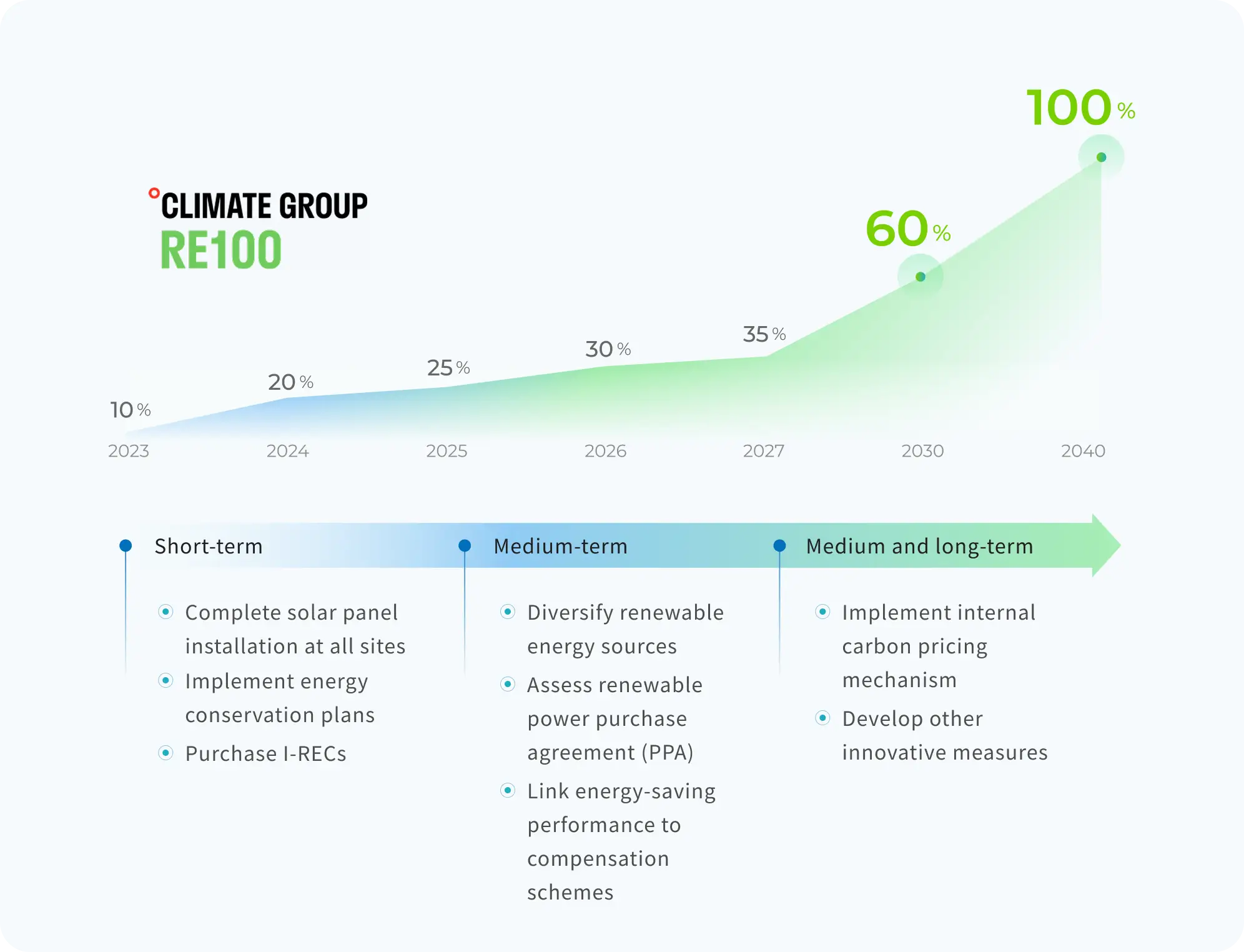
To deliver on its RE100 commitment, WNC joined the Asia Clean Energy Coalition (ACEC) in 2025, supporting clean energy policy advocacy and energy transition in Vietnam. In addition, by installing solar panels, purchasing I-RECs, and implementing energy-saving measures, renewable energy accounted for 34.47% of WNC’s energy use in 2025 — exceeding the annual target of 25% and representing more than a fivefold increase from 2022. Total renewable energy use reached 52,184.97 MWh. Currently, WNC’s solar farms across all sites have a total installed capacity of 11.5 MWh, 8,684.97 MWh of which was for self-use.
In recent years, WNC has continued to install additional solar panels at its major manufacturing sites in Taiwan, Kunshan, and Vietnam. The company was able to increase self-generated electricity for self-consumption through the termination of solar feed-in arrangements and the optimization of rooftop layouts to support additional solar panel installations. At WNC headquarters in Taiwan, solar panels were installed using canopy style and fish-scale style configurations, and the panels are expected to generate 532,380 kWh of electricity annually.
Four-year Renewable Energy Usage (MWh)
Renewable Energy Target & Strategy
短期
- 廠房完成太陽能板鋪設
- 落實節能方案
- 再生能源憑證採購
中期
- 提升再生能源多元性
- 評估再生電力購電協議
- 能源績效連結薪酬機制
中長期
- 導入內部碳定價
- 發展其他創新作法
Carbon reduction results of energy-saving projects in 2025
WNC has continued to implement energy-saving initiatives across five major systems — production processes, lighting, exhaust, air conditioning, and compressed air — with the aim of improving energy utilization efficiency and reducing Scope 1 and Scope 2 greenhouse gas emissions. In 2025, WNC implemented 66 energy-saving projects, which are expected to save 10,207.50 MWh of electricity, equivalent to 6,029.69 tonnes of CO2e.
| System | Carbon reduction scope | No. of projects | Electricity saved (MWh) | Carbon reduction (tonnes CO2e) |
|---|---|---|---|---|
| Illumination | Scope 2 emissions | 21 | 739.08 | 392.15 |
| Exhaust | 3 | 39.82 | 18.88 | |
| Air conditioning | 19 | 4,389.72 | 2,841.35 | |
| Air compression | 11 | 1,949.19 | 1,164.64 | |
| Manufacturing processes | 6 | 1,190.52 | 712.46 | |
| Others | 3 | 33.55 | 15.90 | |
| Total for the year | 63 | 8,341.87 | 5,145.38 |
Note
According to the Heat Content of Energy Products table and the Abbreviation & Equivalents of Energy Units table in the Energy Statistics Handbook 2025 published by the Bureau of Energy:
- 1 liter of diesel = 10.0337 kWh = 0.0361 GJ
- 1 cubic meter of natural gas = 10.1279 kWh = 0.0365 GJ
- 1 liter of gasoline = 8.7442 kWh = 0.0315 GJ
Featured case of the year
Highlight
Energy-efficiency initiatives at overseas sites
WNC actively implements environmental sustainability by promoting various energy-saving initiatives at its Vietnam and China sites.
| Vietnam | WNC is advancing environmental sustainability by implementing a number of energy-saving initiatives at its Vietnam and China sites. While expanding production capacity, the Vietnam site was able to reduce electricity use by 125,000 kWh (equivalent to approximately NT$2.87 million in electricity costs) through energy management measures such as shutting down non-essential fans and air compressors on weekends and adjusting the frequency settings of air conditioners and exhaust fans according to production needs. In addition, Phase III expansion of the site has been designed primarily according to green building principles and is expected to obtain green building certification in the fourth quarter of 2026. |
| China | WNC sites in China have replaced legacy equipment with energy-efficient models, integrated cross-building systems, and optimized space utilization on production lines, reducing carbon emissions by 480.83 tonnes of CO2e. Some specific measures relating to the above paragraph include:
|