

Environment
Green innovation
Green product design and management
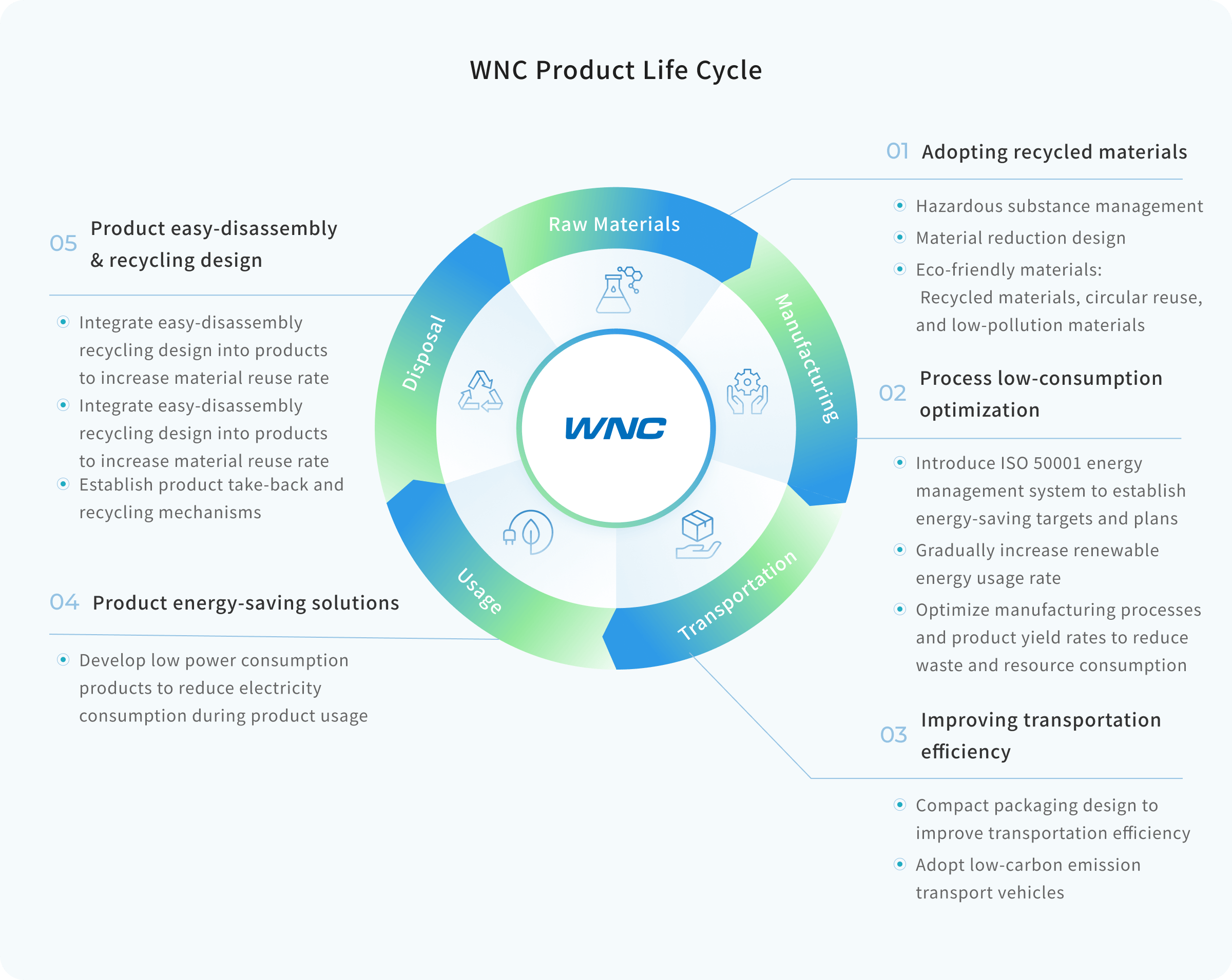
WNC is dedicated to the development of communications technologies and green products. Within its green product line, the company focuses on two major requirements: safety and low carbon emissions. WNC requires all products to be free from environmentally harmful substances and compliant with prohibited and restricted materials regulations, ensuring products are harmless to human health and the environment. The company is committed to reducing carbon emissions across all stages of the product lifecycle: raw material procurement, manufacturing, transportation, product use, and waste disposal, thereby minimizing overall climate impact.
Design For Green (DFG)

WNC adopts the PESTEL analysis approach, incorporating “meeting customer needs,” “complying with international regulations,” “reducing environmental impact,” and “promoting business growth” as key strategic directions in order to take into account environmental and market requirements from the product design stage. WNC has established a detailed checklist as green design indicators in the following five DFG categories: circular design, energy conservation, material usage, waste reduction, and green manufacturing. Through a data management platform, WNC tracks the implementation status of these indicators in each unit and for each product in real time, while continuing to work toward its goal of achieving 100% green products through cross-functional collaboration.
Environmental benefits of green products
Through LCA hotspot analysis, WNC classifies its products into two management categories: "low-carbon emissions" and "avoiding emissions.” WNC also initiated a green labeling program in 2024 to help implement green design and enhance customer trust.
EcoLogo®
In 2024, WNC submitted an international green label application for one of its Wi-Fi extenders, and in 2025 this product was awarded the EcoLogo® certification, becoming the first WNC product to receive this certification. The product provides customers with a sustainable solution while demonstrating WNC’s commitment to achieving zero emissions and zero waste.
Sony Green Partner certification
Starting from 2007, WNC, Wistron NeWeb (Kunshan) Corporation, and WebCom Communication (Kunshan) began acquiring green partner certification from Sony and other leading companies and passing ongoing annual recertification.
Revenue proportion from green products in 2025
Product type | Revenue share | Definitions and main action plans | Carbon reduction (tonnes CO2e) |
|---|---|---|---|
Material manufacturing: low carbon emissions | 53.53% | Use of low-carbon materials and packaging materials
| 2,129.00 |
Optimization of low-carbon processes
| 14,939.33 | ||
Consumer use: prevent emissions | 16.64% | Energy-efficient design
| 1,528.24 |
Design for easy disassembly and easy recycling
| - |
Note The amount of carbon emissions cut is estimated based on the variance in emissions between products improved by green design and their predecessors. Since products are used in different regions, the latest electricity carbon emission factors of the current year from their respective regions are adopted for this calculation: 0.5568 kgCO2e/kWh for China sites and 0.3753 kgCO2e/kWh for U.S. sites.
Circular economy and sustainable materials management
Recycled material management
WNC proposes the use of diverse recyclable/recycled materials to customers based on customers’ expected product specifications and the usability and durability requirements of communications products. WNC’s Mechanical and Industrial Design Division has initiated an Environmentally-friendly Attributes Database of Mechanical Components project in 2022. This database consolidates the sustainable attributes of different materials to help reduce carbon emissions and waste. With this data, R&D teams can select the most appropriate materials during the design and material selection stage.
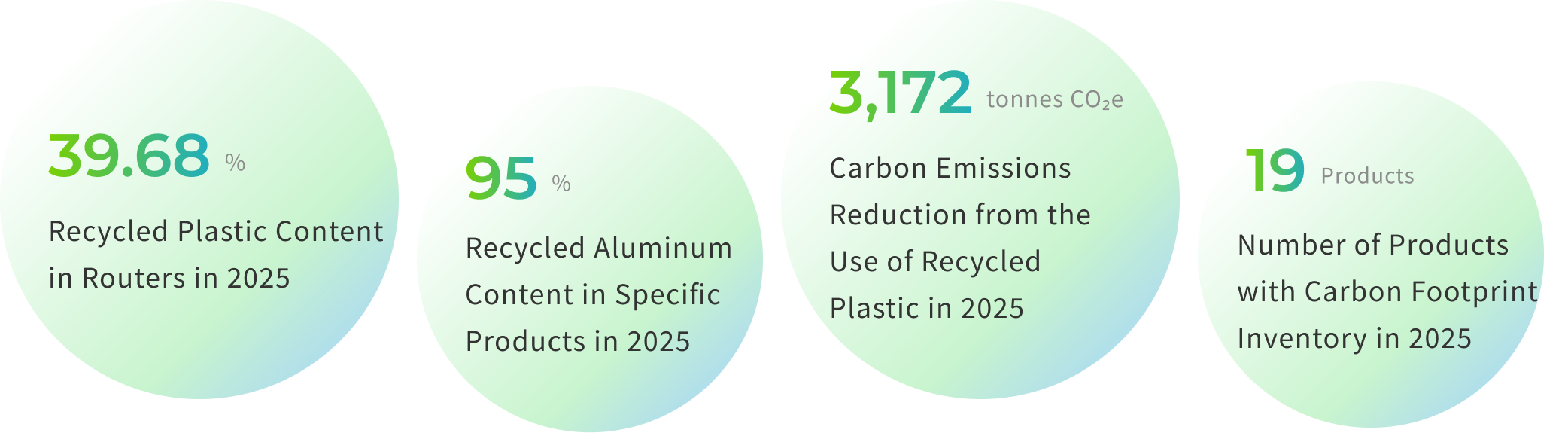
In the area of recycled plastics development and usage, WNC’s Life Cycle Assessment (LCA) analysis results show that the raw material selection stage has a significant impact on all environmental indicators. Therefore, without compromising product quality, WNC has collaborated with suppliers to develop recycled plastics for use in different mechanical components and packaging. In 2025, recycled plastics accounted for 39.68% of the plastics used in WNC routers. The company also conducts environmental qualification testing (EQT) to ensure the safety of recycled plastics used in its network communications products.
Regarding circular use of metal materials, WNC conducted an inventory and analysis of metal components in a specific product in 2024. In the following year, the proportion of recycled aluminum used in this product reached 95%. Moving forward, the company will continue to assess the feasibility of applying circular economy principles to its products to better manage the consumption of rare metals and increase the adoption of recycled metals, and minimize the company’s reliance on virgin resources.
Recycled plastic usage
Item | 2023 | 2024 | 2025 |
|---|---|---|---|
Total amount of plastics used (tonnes) | 3,376 | 4,413 | 4,397 |
Proportion of recycled plastics used to total plastics used | 8.82% | 16.88% | 28.89% |
Amount of carbon emissions reduced compared to if all plastics used were virgin plastics (tonnes CO2e) | 1,426 | 2,129 | 3,172 |
Metal Raw Materials
WNC tracks the metal raw materials contained in its products in order to manage resource use and supply chain risks and to increase the use of recycled metals. The table below shows the amount of each metal used in WNC's products in 2025 and the percentage from recycled sources.
2025 Metal raw materials used in products
Metal | Amount (metric tonnes) | Percentage from recycled sources |
|---|---|---|
Aluminium | 3,799.74 | 0.66% |
Copper | 37.33 | 2.41% |
Iron/steel | 1,510.85 | 0% |
Cobalt/ Nickel/ Lithium/ Titanium | Not applicableNote | Not applicableNote |
Notes: Excludes metals used in product packaging. In WNC's products, cobalt, nickel, lithium, and titanium are present only as trace plating on purchased electronic components. The quantities are minimal and not material. Therefore, these metals have no dedicated part numbers in the Company's Bill of Materials (BOM), and they are not tracked separately.
Sustainable packaging and waste reduction
The packaging materials used to ship products, including corrugated cardboard, EPE, plastic bags, labels and stickers, manuals, pulp boxes, and blister shells, are all recyclable and environmentally-friendly materials. Such materials comply with the restrictions on the four hazardous materials of lead (Pb), cadmium (Cd), mercury (Hg), and chromium (Cr6+) in the EU’s Directive of Packaging and Packaging Waste (PPWD) 94/62/EC. WNC also implements packaging reduction strategies.

Optimized packaging volume and logistics decarbonization
WNC strives to reduce packaging volumes to improve space utilization and container loading efficiency. This lowers energy consumption and carbon emissions during transportation.

FSC™ CoC
WNC implemented FSC™ at the end of 2014 and obtained CoC certification from the FSC™ in 2015. Through rigorous internal audits and third-party verification, WNC ensures that all color boxes, corrugated paper bags, and printed paper materials are sourced from certified plantations, fulfilling the company’s responsibility to protect and responsibly manage global forest resources.

Cradle to cradle (C2C) certification and application
WNC has adopted certified packaging materials, which are characterized by the use of non-toxic materials, clean energy, and water-saving manufacturing processes. These materials include reinforced kraft paper tape for sealing product boxes and vegetable oil-based ink for color box printing, both of which are free of VOCs. In addition to being environmentally friendly, these choices safeguard the health and safety of our frontline workers.
Product lifecycle assessment (LCA)
WNC conducts product carbon footprint and lifecycle assessments to develop relevant improvement measures, implementing low-carbon management at the source through the following three initiatives:

Carbon footprint workshop
With the assistance of international certification bodies, a total of 40 WNC employees across three BGs completed a combined 24 hours of LCA training in 2025. The training covered the product environmental footprint (PEF) methodology promoted by the EU. Over a three-month period, the aforementioned employees completed comprehensive cradle-to-grave inventories for three products — an imaging-tracking product, a network product, and a Wi-Fi range extender — which together accounted for approximately 2.4% of WNC’s shipment volume in 2025. Each product was evaluated and analyzed against 16 environmental impact categories to identify ways to increase the use of recycled materials, improve energy efficiency, and enhance waste recycling rates. Among these, the Wi-Fi range extender successfully obtained ISO 14044: 2006 LCA certification.
Product carbon footprint inventory
In 2025, product carbon footprint inventories were conducted for 19 products, representing approximately 5.16% of WNC’s total shipment volume for the year. Based on the inventory results, the company analyzed carbon emission hotspots and formulated redesign plans. WNC is also gradually incorporating carbon footprint data into its raw material database to improve the efficiency of carbon inventory taking and management in the future.
Green BOM database
WNC has established a Green BOM database that contains raw materials data measured by the company along with those from value chain partners. This database is integrated in real time with the R&D material selection system, enabling development teams to conduct LCA from the start of the design stage and implement low-carbon material selection. This significantly reduces the time and labor costs for data collection.

Hazardous materials and product safety management
Guided by environmental friendliness and user health, WNC has established Green Product Hazardous Substances Management Procedures to ensure that its products fully comply with international directives, including RoHS, REACH SVHC, and WEEE. In 2025, none of WNC's shipped products violated any provisions of international green directives.
WNC requires suppliers to upload composition analysis and test reports to its Green Product Management System. This helps ensure that all components and accessories comply with international standards. The company has also implemented lead-free and halogen-free manufacturing processes and rigorously monitors incoming materials at its sites using x-ray fluorescence (XRF) analyzers. WNC has also implemented the IECQ QC 080000 standards on top of the ISO 9001 and IATF 16949 standards to ensure the reduction in use of hazardous substances.
With respect to product safety and health, 70 of the company’s products passed fire and radiation safety tests in 2025 in accordance with IEC 62368 and IEC 63000 standards. In addition, all of WNC’s products have passed electromagnetic compatibility (EMC) testing, ensuring safe and stable operation in a variety of environments and preventing these products from interfering with other equipment.
Featured case of the year

Highlight
Green packaging: replacing plastics with bamboo
In response to global plastic reduction trends and net-zero goals, from 2024 to 2025 WNC worked to develop an innovative antistatic packaging made from recycled materials to reduce reliance on the plastic brackets traditionally used in anti-static packaging. By using innovative bamboo fiber compound materials and leveraging the natural conductivity of charcoal and molded pulp technology, the company has created highly efficient, low-carbon anti-static packaging materials for electronics. Made entirely from bamboo, these packaging materials are biodegradable, have carbon-negative potential, and meet the stringent anti-static protection standards for electronic components without the use of plastics.
As the technical feasibility of this packaging material has been proven, moving forward WNC will increase its manufacturing R&D and pilot the integration of virgin pulp for structural optimization. This will enhance the packaging's premium feel and overall commercial competitiveness and provide customers with more choices when it comes to sustainable packaging.
Highlight
Innovative green product: Low Carbon Laminated Antenna
Most existing antenna products on the market use traditional PCB/FPC manufacturing processes. These processes require significant amounts of chemicals, imposing a heavy environmental burden. By collaborating with suppliers to use copper foil as an alternative, WNC was able to reduce the chemical pollution, water usage, and energy consumption at the source, thereby lowering carbon emissions while enhancing the circular-recycling value of the materials.
In 2025, a major milestone was achieved: WNC completed feasibility evaluation and performance testing for single-panel antennas made using this new manufacturing process. Currently, this new process can be used for basic antenna designs without issue, and the company has also overcome the limitations previously associated with its use in highly complex antenna modules. WNC has applied for a patent for this process to secure a competitive advantage for itself. The company has promoted this process to customers, communicating the advantages of green design and working to convince customers to use this process for mass production.
WNC has also collaborated with a team from National Taiwan University to conduct LCA on antenna made using this new process. LCA results showed that, as this new process did not use electroless-plating and does not generate wastewater, it reduced environmental impact by 80% compared with conventional manufacturing processes and performed exceptionally across all assessment indicators. This process can help customers reduce their impact on the environment during the R&D, design, and manufacturing stages. It also substantially enhances the sustainable competitiveness of products, aligning with the current global trend of green transformation.