

Workplace
Respect for Human Rights
Human rights policies
WNC complies with the Universal Declaration of Human Rights, the UN Global Compact, the UN Guiding Principles on Business and Human Rights, OECD Guidelines for Multinational Enterprises on Responsible Business Conduct and the RBA Code of Conduct. It does not discriminate against employees based on their gender, sexual orientation, age, race, nationality, religion, marital status, or political views. In 2025, WNC launched a Human Rights Policy, extending human rights protection to employees, customers, suppliers, partners, and subsidiaries. Through comprehensive training, grievance and communication mechanisms, and rigorous due diligence, WNC is dedicated to safeguarding human rights. WNC incorporates human rights concepts and related regulations into new and existing employee training and has established diverse and transparent proposal and communication channels. Additionally, the company regularly reviews its performance and track progress on issues such as the prevention of child labor and minor workers, forced labor, sexual harassment, labor-management communications, and freedom of expression.
Human rights management structure

Policy and Organization
- Establish a human rights policy and conduct regular annual reviews
- The Board of Directors serves as the highest decision-making body
- Sustainability Development Committee coordinates and oversees related efforts
- Social Responsibility Working Group is responsible for implementing specific initiatives
Identify Human Right Risk
- Adhere to the RBA Code of Conduct and government regulations
- Internal and external grievance channels
- Questionnaire surveys
- External assessments
Mitigation and Remediation Measures
- Develop policies and improve management systems
- Raise awareness through education and communication
- Establish early warning mechanisms
- Implement remediation measures
Improvement and Engagement
- Management and improvement by the responsible departments
- Regular monitoring of specific human rights issues
- Public disclosure and external reporting
- Accessible communication channels
WNC ensures robust human rights management across the value chain, spanning employees, suppliers, contractors, customers, and local communities, while safeguarding the surrounding environment. This commitment is realized through clear policy guidance, due diligence, and transparent grievance mechanisms. In compliance with relevant regulations, no WNC sites employ workers under the age of 16. In 2025, no child labor was employed at any WNC site. In response to the global focus on living wages, WNC launched a training session dedicated to human rights and living wage standards. In addition, the company updated its annual ESG training materials to enhance sustainability awareness among all employees. Looking ahead, WNC will develop a living wage commitment statement in line with international trends to strengthen basic living safeguards for employees, suppliers, and other stakeholders.
Human rights risk identification
Each year, WNC assesses its risks in accordance with global trends, the RBA Code of Conduct, the ISO 45001 management system, and stakeholders’ expectations. In 2025, the company conducted employee “labor rights due diligence,” under which relevant functional units worldwide identified human rights risks based on impact severity and likelihood, ensuring that corresponding management measures are in place and effectively implemented. For more information, go to Management Systems on WNC’s official website.
Medium and high-level human rights risks in 2025 and mitigation measures
| Issues | Risk description | Risks | Policy | Management measures | |||
|---|---|---|---|---|---|---|---|
| Taiwan | Vietnam | China | Mexico | ||||
| Working hours management | Working overtime (more than 60 hours per week/ monthly overtime hours exceed local regulatory requirements) | Medium | Medium | High | High |
| |
| Working more than seven consecutive days | Medium | Medium | High | High | |||
| Labor rights | Sexual harassment/assault, corporal punishment, mental or physical coercion, verbal abuse and threats, concern that the grievance mechanism lacks confidentiality | Medium | Low | Low | Medium | ||
| Ethical management | Unethical or corrupt behavior | Medium | Medium | Medium | Medium | ||
| Intellectual property rights | Loss of the company’s or other companies’ intellectual property rights / leakage of confidential information | Medium | Medium | Medium | Medium | ||
Human Rights Assessment
WNC regularly assesses potential human rights risks and discloses the proportion of the assessment scope covered, the percentage of risks identified, and the rate at which risk mitigation actions were undertaken.
| Category | A. Percentage of total assessed in last three years | B. Percentage of total assessed (column A) where risks have been identified | C. Percentage of risk (column B) with mitigation actions taken |
|---|---|---|---|
| Own operations | 100% | 9.52% | 100% |
| Tier 1 suppliers | 100% | 13.43% | 100% |
| Joint ventures | WNC currently has no joint ventures. | ||
Remedial measures
| Human rights issue | Mitigation measures | Remedial measures in 2025 | Affected parties |
|---|---|---|---|
| Work hours | Improvement on processes
Early warning mechanisms
| Zero penalty cases for violations of working-hours regulations in 2025. | EmployeesNote |
Improvement on processes
Service contractors (on-site):
Awareness program
|
| Suppliers | |
Improvement on processes
Awareness program
| There were zero penalty cases for violations of working-hours regulations by contractors in 2025. | Contractors | |
| Labor rights | Policy formulation
Awareness program
Facility upgrade
| In 2025, WNC received 12 workplace grievance complaints regarding workplace bullying and sexual harassment. All cases have been closed after internal investigations and the implementation of disciplinary actions. Correction
| Employees |
| Ethical management | Policy formulation/Improvement in processes
Awareness program
| In 2025, WNC received 16 complaints. Among these, eight concerned personal integrity and six lacked concrete evidence. The remaining two substantiated cases involved an employee’s unauthorized modification of machine data and an employee’s excessively close interactions with a supplier, respectively. Appropriate disciplinary actions were taken, and department heads strengthened employee training. | Employees, suppliers |
| Intellectual property rights | Policy formulation/Improvement in processes
Awareness program
| In 2025, there were no intellectual property-related litigation cases. | Employees, customers |
Note To protect employee rights and interests, employees working overtime may request overtime compensation or compensatory leave, subject to the procedures of each site.
Prevention of Workplace Harassment
To safeguard employees from workplace harassment, including physical, verbal, and psychological abuse as well as sexual harassment, WNC established Regulations on the Reporting and Handling of Workplace Harassment. The HR department is responsible for managing the corresponding prevention, grievance, and disciplinary mechanisms. Within 24 hours of receiving a complaint, a task force consisting of personnel from the HR and legal departments and the units of the involved parties is formed. The task force investigates, interviews, and reviews before submitting a report to the CEO. In 2025, WNC received 12 workplace grievance complaints, comprising 10 cases in Taiwan, one in Vietnam, and one in the United Kingdom. These incidents consisted of six workplace bullying cases and six sexual harassment cases. Internal disciplinary actions were taken, and all cases have been closed.
Remedial measures include reviewing and adjusting work procedures, enhancing security monitoring, increasing promotion, initiating investigation procedures and implementing appropriate disciplinary actions. In 2025, WNC continued to promote its “A Workplace You Can Feel Safe In – Workplace Well-being” series of activities, including mandatory training for all employees and dedicated sessions for managers on “Preventing Unlawful Infringement in the Workplace and Preventing Workplace Sexual Harassment.” Through lectures on gender equality, WNC enhances employee awareness of personal rights and responsibilities, fostering a friendly and inclusive workplace. In compliance with local cultural and statutory requirements, WNC’s China, Vietnam, and Mexico sites have also established internal grievance mechanisms to address complaints, including those concerning sexual harassment. The HR department is responsible for conducting investigation, implementing appropriate measures, and notifying the involved parties, while employee representatives and the union supervise all related procedures.
General Principles for Reporting and Handling Workplace Harassment

Step 1
Employees’ complaints or reports of workplace harassment incidents
Step 2
The Human Resources Department receives and is responsible for investigating
Step 3
Disciplinary action, reporting, and feedback to the parties involved in the incident
Step 4
Strengthen employee training and awareness campaigns to foster a safe workplace together
A Workplace You Can Feel Safe In
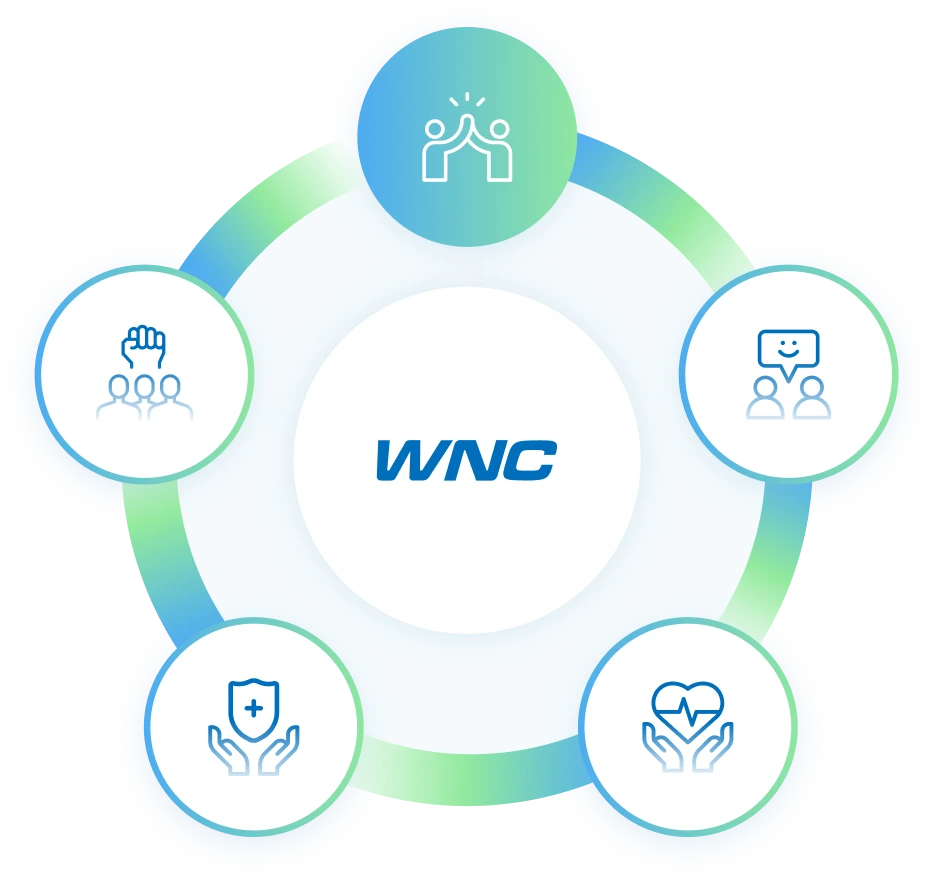
WNC introduced the “A Workplace You Can Feel Safe In” initiative at its Taiwan sites in 2021. The goal of this initiative is to create a workplace that ensures, emphasizes, promises, and protects the physical and mental wellbeing of employees. Through its Five Elements of Workplace Well-Being, WNC creates a friendly workplace where employees can feel safe. Following the introduction of this initiative at its China and Vietnam sites in 2025, WNC plans to expand it to the United States, Mexico, and Europe in 2026, progressively building a globally friendly workplace.
WNC's Five Elements of Workplace Well-Being
Common good of WNC employees
Diversity and inclusion
Safety & Health
Healthcare
Consultation & Assistance
Common good of WNC employees
- WNC continues to offer training courses on Preventing Unlawful Workplace Infringement and Combating Workplace Sexual Harassment, including general courses for all employees and dedicated sessions for supervisors, to strengthen responsibility awareness and response capabilities across different roles.
- WNC hosted lectures on gender equality to enhance employee awareness of diversity and equality.
Diversity and inclusion
- WNC respects employees’ self-identification regarding gender, marital status, ethnicity, political affiliation, and religion.
- In 2025, WNC focused on cross-cultural and cross-generational themes, hosting a multicultural carnival and Intergenerational Communication Salon in Taiwan to foster interpersonal understanding and dialogue.
Safety & Health
- Leveraging educational videos, WNC enhances employee understanding of equipment safety and hygiene management.
- WNC’s employee cafeterias serve organic vegetables. In 2025, WNC received the Organic and Eco-Friendly Ingredients Utilization Award from the Green Dining Guide.
Healthcare
- WNC launched an influenza prevention initiative in 2016, providing all employees with free vaccinations. In 2025, a total of 2,461 vaccinations were administered, achieving a vaccination rate of 42.18%.
- Conducted health awareness training for employees on overseas business trips and subsidized preventive vaccines.
- All WNC sites in Taiwan obtained the Health Promotion Administration’s “Workplace Health Promotion Self-Assessment” certification.
Consultation & Assistance
- WNC integrated an Employee Assistance Program with a digital app to provide timely and professional consultation services. In 2025, 112 employees utilized this service.
Employee Communication
WNC provides open and transparent feedback and communication channels to facilitate two-way and immediate dialogue with employees. In addition, public email addresses for stakeholder interaction and the reporting of violations are provided for employees to raise questions, offer suggestions, or file complaints with or without disclosing their identity.
Communication channels at WNC sites
| Communication mechanism and participants | Taiwan sites | China sites | Vietnam site | Mexico Site | |
|---|---|---|---|---|---|
| Consultative organizations | All employees |
| Labor unions  | Labor unions | Labor-management committee |
| Physical mailboxes | Plant manager’s mailbox | Suggestion box | Suggestion box | Physical mailboxes | |
| System platforms | Employee Suggestions Platform | WeChat public platform | - | HR online platform | |
| Email addresses | - | - | Plant manager’s mailbox [email protected] | [email protected] | |
| Hotlines | - | 8585 employee care hotlines | - | - | |
| Forums | All employees | A Talk with the CEO forums | Employee Representative Forums | Employee Representative Forums | Town hall meeting |
| Production line employees | Plant manager/shift manager/foreign employee forums | DL forums | Shift manager forums | Production line forums | |
| New employees |
| New employee forums | - | New employee forums | |
| Management | - | IDL/personnel on overseas assignment forum | Cultural experience forum for foreign managers | - | |
| Complaint mechanisms | All stakeholders |
| |||
Note「 」The main channel at each site
Percentage of Global Employees Covered by Collective Bargaining Agreements
| 年度 | 2022 | 2023 | 2024 | 2025 |
|---|---|---|---|---|
| Percentage of global employees covered by collective bargaining agreements (%) | 42.19 | 35.91 | 42.61 | 53.26 |