
Governance
Global Supply Chain Management Policy
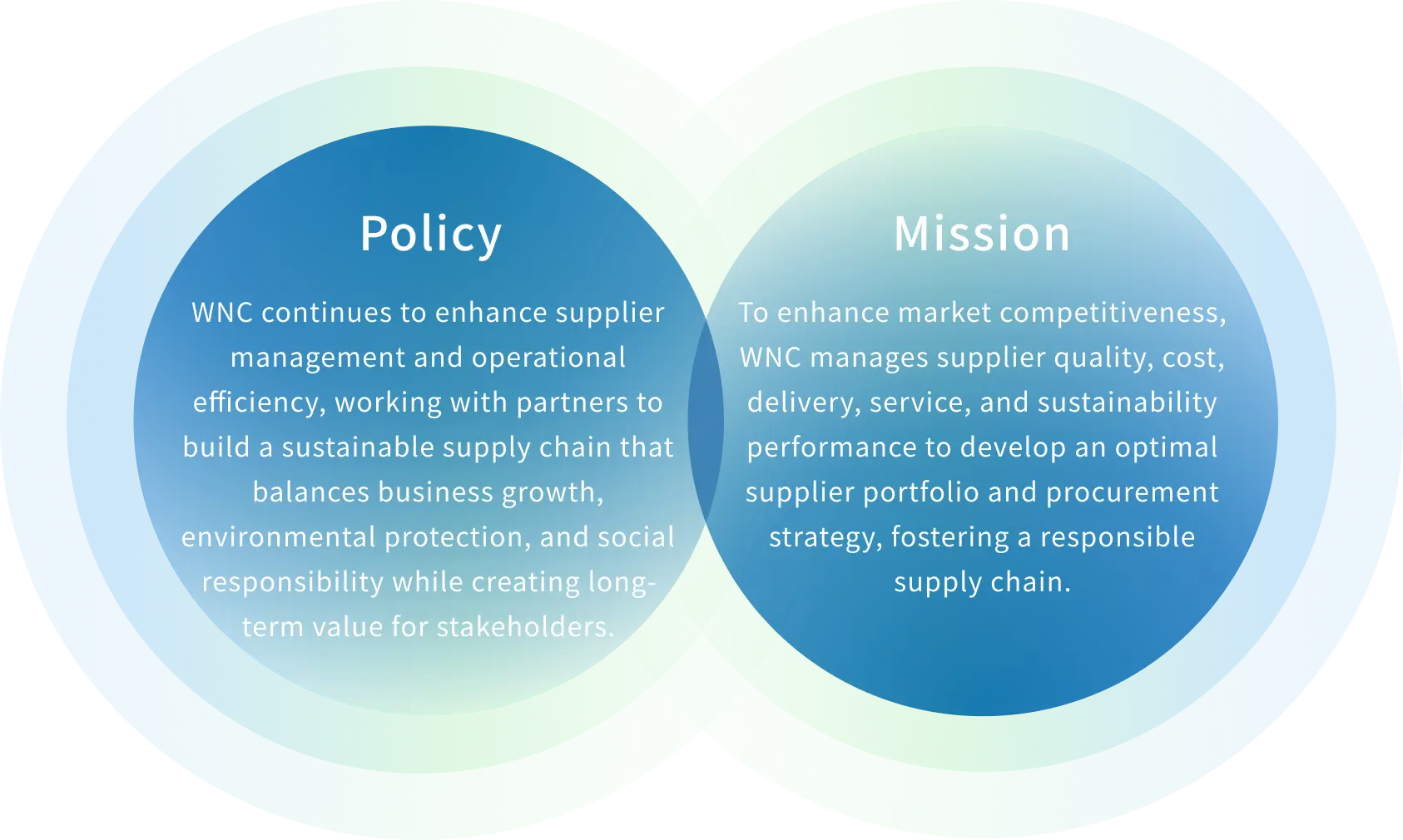
政 策
啓碁持續優化供應商管理與營運效率,攜手夥伴打造永續供應鏈,平衡企業成長、環境保護與社會責任,為利害關係人創造最大價值
使 命
以提升市場競爭力為前提,全面管理供應商品質、價格、交期、服務及永續表現,發展最適供應商組合與採購方針,共創負責任的供應鏈
WNC’s Board of Directors is the highest governance body for sustainable supply chain management. The Corporate Governance Working Group under the Sustainable Development Committee is responsible for oversight. The Global Supply Chain Management Division and Quality Assurance Division serve as the primary units responsible for sustainable supply chain management, and these units regularly review the implementation status of related projects.
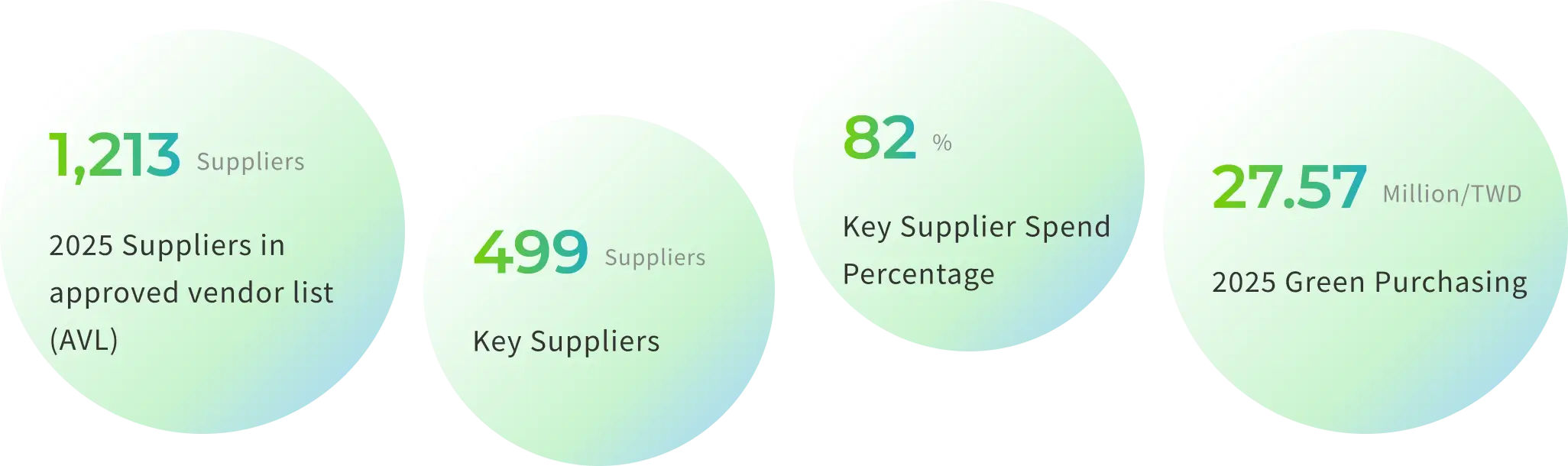
The materials and components WNC purchase are mainly integrated circuits, circuit boards, display panels, electromechanical components, mechanical parts, and packaging materials. In 2025, there were 1,213 qualified suppliers of raw materials, components, and manufacturing consumables to WNC's sites. Among them, 499 are tier-1 or key suppliers, with key suppliers accounting for 82% of total procurement spending.
- 2025 Suppliers in approved vendor list (AVL) 1,213 Suppliers
- Key Suppliers 499 Suppliers
- Key Supplier Spend Percentage 82%
- 2025 Green Purchasing 27.57 Million/TWD
Local procurement and green purchasing
According to the amount of raw materials, components and production consumables purchased by WNC, suppliers in Taiwan are WNC’s main suppliers, while other suppliers are located in Asia, Europe and the United States.
WNC prioritizes office supplies and IT equipment that meet the Ministry of Environment’s green procurement criteria or carry recognized domestic or international environmental labels. In 2025, green procurement at its Taiwan sites totaled approximately NT$27.57 million, accounting for 93.68% of total office equipment purchases.
Distribution of WNC suppliers in 2025 (by purchasing amount)
Supply chain management framework
- Sign the Supplier Commitment to Sustainability Declaration (98.4% signed in 2025), Supplier Integrity Commitment Letter, Information Protection Commitment Letter, Restriction Plan Acknowledgment Form, and Legal Compliance Commitment Letter, and respond to the Supplier ESG Questionnaire
- Commit to comply with the Supplier Code of Conduct, including prohibitions on child and forced labor; implementation of occupational health and safety management; anti-bribery and anti-corruption practices; fair trade; and respect for workers’ right to collective bargaining
- General materials suppliers are required to obtain ISO 9001 Quality Management System certification, and automotive parts suppliers are required to obtain IATF 16949 certification
- WNC uses EcoVadis to assess suppliers’ sustainability risks, and incorporates the resulting ratings into supplier performance evaluations. In 2025, 499 key and tier-1 suppliers participated in the assessment. Among them, 472 completed the evaluation and received an ESG score, representing a 94.6% completion rate
- WNC applies the RBA framework to assess supplier risks across labor, ethics, health and safety, environmental performance, and management systems. Suppliers are categorized as A (high risk), B (medium risk), or C (low risk), with selected suppliers audited annually. Conducts annual RBA audits of 50 key and tier 1 suppliers. In 2025, 59 suppliers were audited, achieving a 118% completion rate. No supplier relationships were terminated due to non-compliance

- Conducts quarterly Vendor Performance Evaluations (VPEs) covering quality, delivery, service, and price competitiveness. Completed 390 audits and performance follow-ups in 2025
- Uses VPE results to develop the Recommended Vendor List (RVL), guiding supplier selection for new projects and purchase orders
- Requires RVL suppliers to hold ISO 14001 and ISO 45001 certifications
- In 2025, 67 suppliers were rated with higher risks and 38 were included in the audits
- Reward: Provide opportunities to participate in new projects; where appropriate, add the vendor to the quarterly RVL or the preferred key supplier list
- Elimination: If a supplier underperforms in leading indicators, experiences significant business or product quality anomalies or is unwilling to implement sustainability performance evaluation, the issue will be reported, and appropriate action will be taken according to relevant management procedures
Supply chain environment and social action

WNC promotes green products by requiring suppliers to sign the Supplier Quality Agreement and the Supplier Declaration of Compliance on the Non-Use of Environmentally Hazardous Substances. Suppliers must also comply with WNC’s Environmental Hazardous Substances Standard to ensure products meet RoHS, REACH, POPs, and battery-related regulatory requirements, strengthening restricted-substance management across the green supply chain. WNC incorporates hazardous substance controls into incoming material inspections. Suppliers of non-compliant materials must take immediate corrective and preventive actions, while critical components are approved through the Production Part Approval Process (PPAP) to reduce quality risks, production waste, and social costs at the source.
Supply chain carbon reduction
In 2023, WNC signed the SBTi Commitment Letter and committed to achieving net-zero Scope 3 emissions by 2050, driving our suppliers to create a low-carbon supply chain. WNC regularly issues a Sustainability and Greenhouse Gas Inventory Information Questionnaire to suppliers with potential sustainability or high carbon emission risks. Covering energy and carbon management, inventory data, decarbonization actions, water management, and sustainability disclosures, the questionnaire enables WNC to monitor supplier sustainability performance and strengthen global supply chain resilience. Since 2025, WNC has implemented a supplier decarbonization target program, prioritizing 66 key high-emission suppliers. Of these, 85% completed carbon inventories and third-party verification. Suppliers are also required to set emissions reduction targets and action plans, with 83% meeting these requirements in 2025 — reflecting growing decarbonization awareness and action across the supply chain.
Nature-related impact management across supply chain
To address the impacts of climate change and ecosystem degradation on operations and the supply chain, WNC incorporates upstream suppliers into its nature- and climate-risk management framework. Using scenario analysis and geographic information systems, WNC identifies high-risk locations and assesses operational dependencies on, and impacts on, ecosystems. More than 70% of Tier 1 suppliers have raised awareness and initiated management actions to address nature-related issues.
WNC continues to strengthen supplier awareness and monitor progress through supplier conferences, educational resources, and its Sustainability and Greenhouse Gas Inventory Questionnaire, driving practical improvements and accountability across the supply chain.
Responsible mineral sourcing
WNC incorporates responsible and conflict minerals management into its supply chain management and sustainability governance mechanisms. The Sustainability Development Center oversees the effectiveness of implementation, while the Procurement, Supply Chain Management, and Quality Management functions jointly manage the promotion of responsible and conflict minerals requirements, supplier communication, data collection and surveys, risk identification, and corrective action follow-up.
WNC does not directly procure raw metals. It uses the Responsible Minerals Initiative (RMI)’s Conflict Minerals Reporting Template (CMRT) and Extended Minerals Reporting Template (EMRT) to investigate and avoid the use of illegally sourced minerals from conflict-affected regions. WNC has established a WNC Responsible Minerals Policy Statement, committing not to accept minerals linked to armed conflict, human rights abuses, or forced labor. Suppliers are required to avoid conflict minerals, disclose the sources of tin, tungsten, tantalum, gold, cobalt, and mica, and communicate these requirements throughout their upstream supply chains. WNC also requires all new suppliers to sign a Quality Agreement, committing not to use conflict minerals and to comply with applicable international conflict minerals laws and regulations. If investigations, supplier data verification, or other risk assessments indicate that the source of minerals contained in components is associated with conflict minerals or conflict-affected and high-risk areas, WNC will prioritize identifying and replacing them with alternative sources that comply with WNC’s Responsible Minerals Policy Statement and the requirements of the Responsible Minerals Assurance Process (RMAP). The survey identified 229 smelters in WNC’s supply chain, of which 219 are conformant or participating in the Responsible Minerals Assurance Process (RMAP), representing 95.6%. WNC will continue monitoring the remaining 10 non-conformant smelters to ensure its products meet customers' conflict minerals requirements. In 2025, products containing minerals sourced from conflict-affected and high-risk areas accounted for 33.81% of the Company’s total revenue.
Revenues from | 2022 | 2023 | 2024 | 2025 |
|---|---|---|---|---|
| Percentage of total revenues from products containing minerals from conflict-affected and high-risk areas | 32.71% | 48.49% | 28.87% | 33.81% |
WNC has established a grievance mechanism for responsible minerals, allowing stakeholders to raise concerns or submit complaints regarding responsible and conflict minerals in the supply chain. These concerns may include the origin of minerals, smelters/refiners, suppliers’ non-compliance with the Responsible Minerals Policy Statement, and potential involvement in armed conflict, child labor, forced labor, or other serious human rights abuses. Stakeholders may submit complaints or raise concerns via email at [email protected].
Sustainable supply chain training
- ISO 20400 永續採購課程培訓人次68人次
- 培訓時數68小時
- 關鍵與一階供應商培訓完成率100%
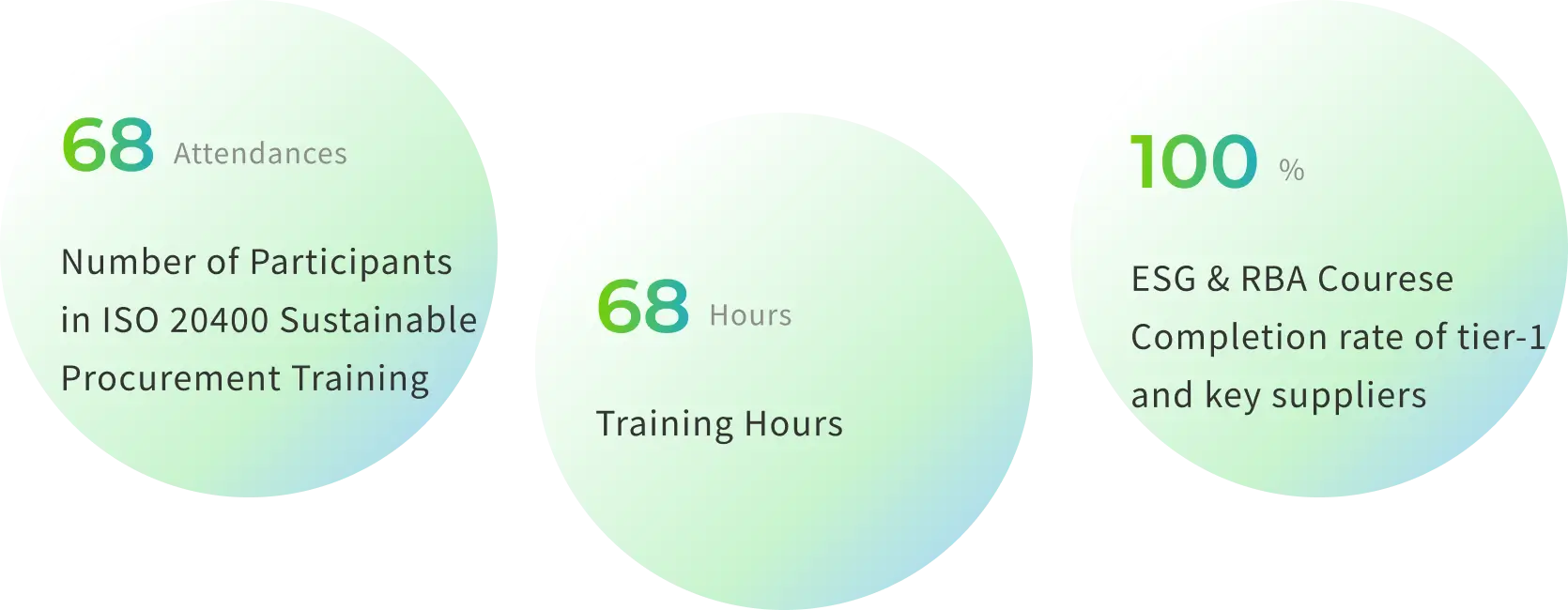
WNC holds sustainable procurement training and makes it mandatory for new procurement employees, embedding sustainable procurement principles into material sourcing and supplier selection and management. In 2025, the Introduction to ISO 20400 Sustainable Procurement Guidance course trained 68 participants with a 100% completion rate. WNC also provides suppliers with an online “WNC ESG & RBA Introduction” course to strengthen their understanding and implementation of the Code of Conduct and anti-corruption requirements. By the end of 2025, all key and Tier 1 suppliers had completed the training.
Featured case of the year
Highlight
Digital Supply Chain Portal (DSCP) for carbon management
Scope 3 emissions are WNC’s primary source of greenhouse gas emissions, making supplier carbon management critical to achieving its SBTi targets. To reduce communication costs and improve data tracking, WNC developed a digital carbon management platform to manage supplier questionnaires. Automated workflows significantly reduce manual effort and enhance the timeliness of information.
The platform requires suppliers to upload supporting documentation, establishing a traceable, high-quality data foundation. This enables WNC to scientifically project supply chain emissions reductions through 2030 and deliver on its sustainable supply chain commitments.

Highlight
Four sustainable supplier conferences in 2025
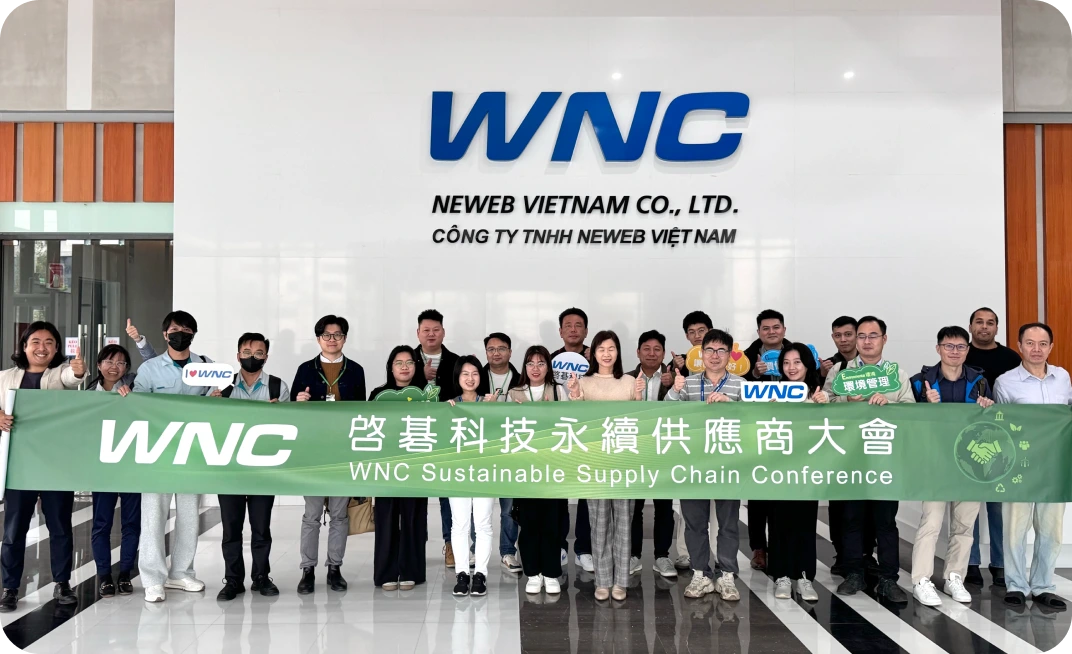
WNC holds a Sustainable Supplier Conference annually and engages in relevant topics with both its suppliers and the internal procurement unit. In 2025, WNC held four supplier conferences, engaging 84 high-emission suppliers. Two of the conferences were held at WNC’s HQ in Taiwan, featuring its sustainability strategy and expert sessions on carbon inventories, cybersecurity, sustainable materials, and human rights. Participant satisfaction reached 4.75 out of 5. Two conferences were also held in Vietnam to communicate WNC’s sustainability strategy and requirements, while providing carbon management training to strengthen local suppliers’ decarbonization capabilities. WNC also invited 103 suppliers to participate in the Wistron Partner Conference, recognizing outstanding partners for their strong performance and contributions. WNC plans to hold an annual supplier conference at the end of November 2026, inviting suppliers with outstanding carbon reduction performance to share their experiences and practical achievements in implementing carbon reduction initiatives, thereby fostering exchange and learning among suppliers. Through case sharing and peer benchmarking, suppliers can identify areas for improvement in their ESG and carbon reduction performance, learn from industry best practices, and continuously enhance their sustainability management capabilities.