

Workplace
Talent cultivation and development
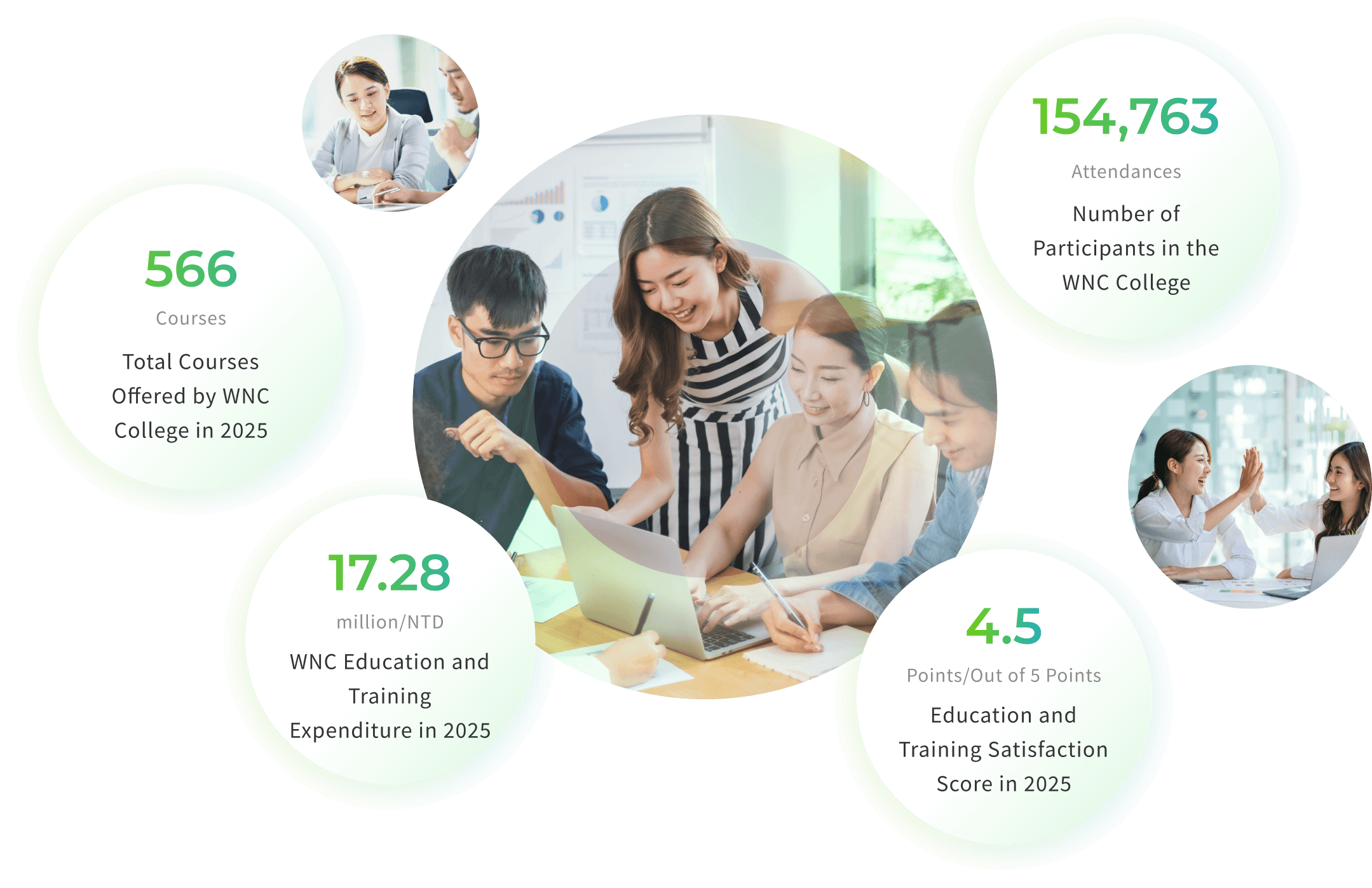
- Number of Courses in 2025:566
- Education and training expenditure:NTD 17.28 million
- Education and training satisfaction score(Out of 5 points):4.5
- WNC Colleges total participations: 154,763
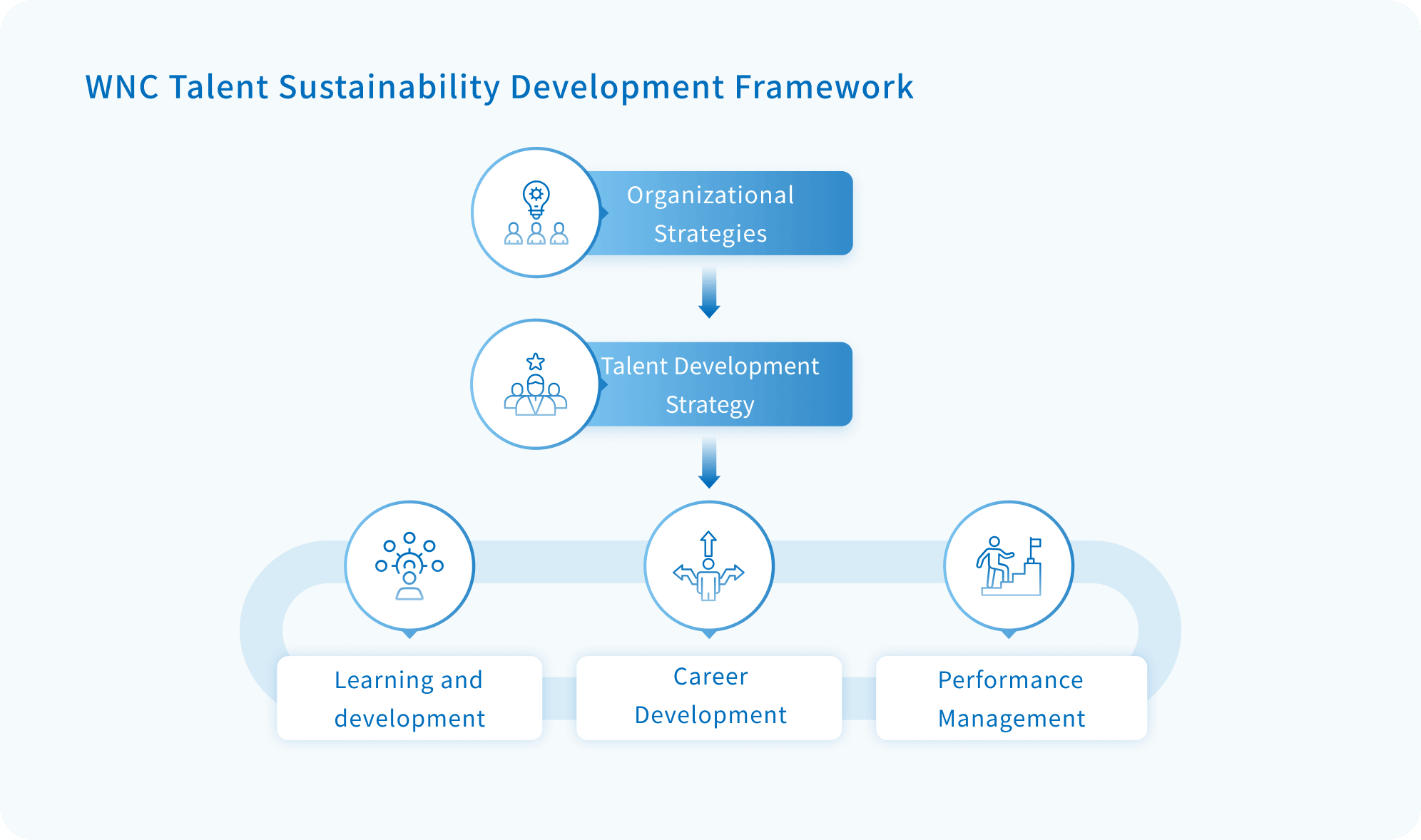
WNC closely aligns its organizational and talent development strategies to ensure the long-term competitiveness of itself and its employees. The company’s talent development initiatives focus on three key areas: learning and development, career development, and performance management. By improving employees’ skill sets, establishing comprehensive career development pathways, and enhancing performance management, WNC is able to build a high-performing organization and create a virtuous cycle of shared growth for itself and its employees.
Dynamic talent management
WNC adopts the Global Career Framework (GCF) as the foundation of its talent management system. The company uses GCF to establish standardized job grades, job responsibilities, and employee development mechanisms, linking recruitment, learning, performance, and promotion processes together. The company has also developed the WNC Skill Library, a comprehensive competency and skills framework, to link corporate strategy with job skills development for each position in order to support organizational transformation and the deployment of critical technologies. All WNC sites recruit talent in compliance with local laws and regulations and provide employees with a safe and healthy work environment as well as training and development opportunities. WNC also develops career development roadmaps according to different job competencies and job grades and encourages employees to continuously up-skill and re-skill.
Worldwide learning system

E-learning system
WNC uses Workday as its global talent development platform, integrating recruitment, performance management, competency assessments, and occupational training in one place. Data analytics is used to help conduct talent reviews, analyze critical job positions, and evaluate the effectiveness of training. Workday is able to plan learning pathways based on the competency requirements of each job position as well as assist managers in formulating Individual Development Plans (IDPs) for their subordinates, ensuring precise alignment between training and job performance. Workday supports multiple languages and time zones and is able to consolidate learning records and training outcomes across all sites, enhancing the consistency, compliance, and audit efficiency of training at WNC sites worldwide while promoting employee self-learning and talent development.
WNC Colleges
WNC Colleges The WNC Colleges are composed of a Digital Leadership College, Business College, R&D College, Smart Manufacturing College, and AI & Digital College. Respective colleges are led by top managers of related units/fields. WNC Colleges reference the company’s corporate strategies and the Education Training Procedure to help improve employees’ job skills and leadership capabilities. The scope of the talent development and training initiatives of WNC Colleges cover permanent, contract-based, and part-time employees. In 2025, WNC Colleges held a total of 566 courses, with a total of 154,763 participations.
College name | Principal | Participant | Purpose | Description | Number of Courses in 2025 |
|---|---|---|---|---|---|
Digital Leadership College | Chief Human Resource Officer | Functional unit supervisors | Aligned with WNC's corporate strategies,management courses focus on developing the management skills of current supervisors and high-potential talent, including skills in leadership, motivation, coaching, and personal growth. General purpose courses help new employees understand the corporate culture, work environment, and system operations. A number of courses around emerging talent trends,such as DEI, are planned to enhance the work efficiency and self-management capabilities of all employees and foster an inclusive workplace. | Management training is structured into different tiers tailored to the needs of leaders at various stages of their careers. Additionally, we have introduced multilingual online courses to expand our leadership development initiatives globally. General purpose courses include newcomer training, ESH related courses and drills, internal instructor training, and talent trend-related seminars. Additionally, training is provided to newcomer counselors so that counselors can improve counseling skills to help new employees shorten the adaptation period and smoothly integrate into the WNC family. | 278 |
Business College | President | Product managers/Sales supervisors | Guided by the company's strategic directions and global market trends, the Business College empowers project managers and sales professionals by enhancing their core expertise.This strengthens the company's value chain, driving sustainable growth and profitability. | The curriculum covers project management,financial literacy, emerging industry trends, and market intelligence. In addition, we invite senior leaders to share experiences of successful customer engagement through case studies and interactive discussions with participants. | 23 |
R&D College | Chief Technology Officer | Product R&D Center/R&D Forum chairperson | Following the company's research and development focus, the establishment of the R&D Forum and the introduction of R&D innovation methods will enrich the research and development staff's own skills and further cultivate new research and development knowledge. Through the R&D Forum, R&D employees can conduct cross-domain technical exchanges, so that R&D employees specializing in different fields can have more comprehensive vision and thinking. | The R&D Forum designs its training roadmap based on product strategies. In 2025, the Forum partnered with NYCU to launch crossdisciplinary courses concerning emerging technologies, aiming to broaden the technical expertise of the R&D personnel. | 80 |
Smart Manufacturing College | General Plant Manager Chief Quality Officer CSCO | Product R&D Center/R&D Forum chairperson | The Smart Manufacturing College enhances our professional expertise and practical capabilities by focusing on three major areas: quality risk management, smart manufacturing and efficiency improvement, and value chain and sustainability management. | By enhancing quality and risk analysis, increasing smart manufacturing applications, and improving efficiency and problem-solving capabilities, the College aims to strengthen supply chain compliance, promote sustainable management, and foster digital crossdepartmental collaboration. These efforts ensure we meet audit requirements while elevating our overall operational capabilities. | 148 |
AI & Digital College | Associate Vice President | Automation unit/Information unit/R&D unit supervisors | The AI & Digital College establishes a universal AI vocabulary and foundational skill set for all employees. Through a tiered learning framework, it systematically cultivates digital transformation talent capable of integrating AI technologies directly into our core business operations. | The College teaches AI knowledge to employees through integration and sharing of internal and external learning resources. AI projects are shared to inspire flexible applications in the various units and promote the impl | 37 |
| Number of Courses in 2025 | 566 | ||||
Viva Engagement Internal knowledge sharing platform (Teams and Networks)
To help employees learn through practical experience and draw on successful examples from across teams, WNC has established a variety of technology-themed forums on the Viva Engagement platform. These forums, covering areas such as WNC Colleges, R&D technologies, product development process innovation, AI trend applications, and RPA technology applications, provide employees and teams with a learning space for sharing, exchanging ideas, and seeking advice, thereby enhancing the effectiveness of technical exchanges.
Mobile learning system

Encouraging participation in internal and external training
WNC encourages employees to participate in external seminars and training courses. External training courses can be fully subsidized with the approval of the supervisor of the affiliated unit. Each employee is eligible for an annual subsidy of up to NT$10,000 for English language training. The company also encourages units to organize study groups. To ensure the quality of course content, participants are surveyed after courses conclude to determine the participants’ knowledge retention and formulate course improvement measures.

Developing a learning organization
To foster a culture of autonomous learning and knowledge sharing within the organization, WNC has launched the “Nurturing talent and growth program.” The company encourages managers at all levels to conduct at least two hours of teaching or experience sharing sessions annually. Topics cover areas such as management practices, professional knowledge/skills, lessons learned, and new trends/technologies. In 2025, 1,284 hours of courses were taught by managers. WNC operates a rigorous internal instructor certification system that includes training, and evaluation through practice teaching, and also takes into account recommendations by managers at overseas sites. By the end of 2025, there were 272 certified instructors, and they were publicly recognized for their work during WNC’s Teachers’ Day appreciation activities.

Project discussion
Regular project meetings, case analyses, and experience sharing are organized to help employees find methods to prevent issues. Through quarterly operations meetings, technical and business exchange sessions, and the WNC Tech Day exhibition, employees from different units can learn skills related to organizational management, product development, and business expansion from one another.
Training participation
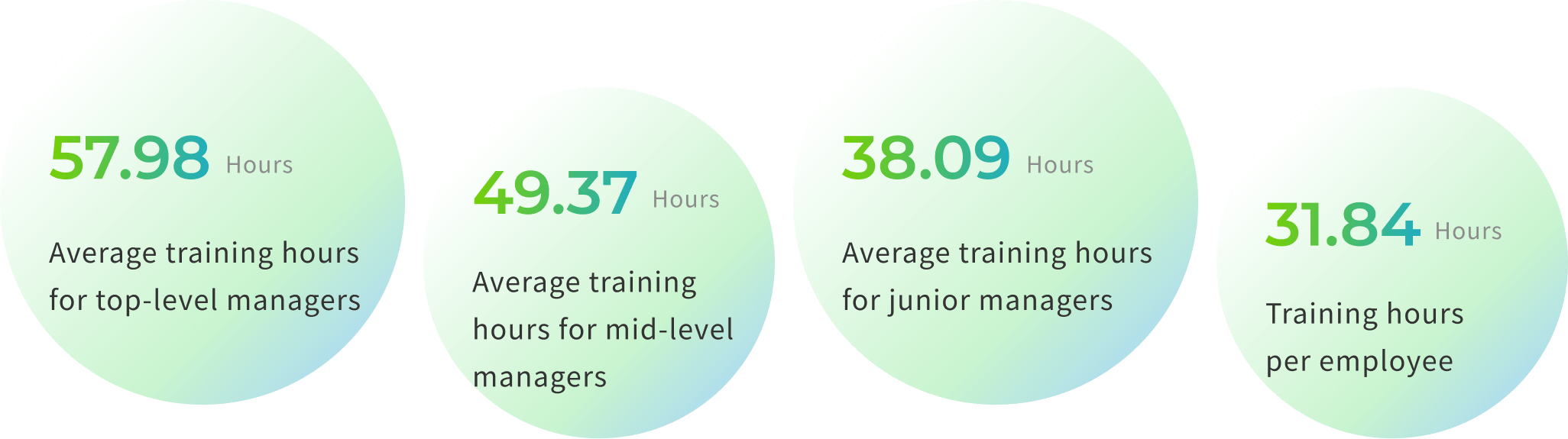
In 2025, WNC employees received an average of 31.84 hours of training, an increase of 6.8% from 2024. To support its global business strategy, WNC introduced the Workday platform to digitize and streamline training, consolidate duplicate courses, improve learning report management, and enable real-time data monitoring. The introduction of Workday has enhanced training efficiency and the quality of course content. Total training expenditures reached NT$17.28 million, with an average training cost of NT$1,127.73 per employee. The overall satisfaction survey score was 4.5 out of 5.
NoteWNC’s global training expenditures are reported in NTD. However, training expenses at the Vietnam site are denominated in US dollars with the following calculation method: monthly expenditures in both currencies are first converted into USD based on the prevailing monthly exchange rate and aggregated. Finally, the annual USD total is converted into NTD.
Performance management

Competence development
Perform competence assessment twice a year and collate supervisors’successful cases as a benchmark for evaluating employees.

Talent development
Find employees showing potential through the performance management process, provide them with training plans, and track results on a regular basis.

Career development
Adopt a dual-track system of both specialized and management positions to provide appropriate planning for employees. Plans are provided according to employee potential and their desired career path.
WNC has established a performance management cycle, comprising three stages: goal setting at the beginning of the period, performance alignment during the period, and evaluation at the end of the period. Evaluations are conducted every six months. Through continuous, two-way performance communication, the company helps managers and employees review goal progress, align work priorities, and reach a consensus on execution and development plans, ensuring that individual contributions grow in tandem with organizational objectives. To promote sustainable talent development, WNC implemented the GCF to make the focus of performance evaluations on goal achievement and the demonstration of competencies at each job grade. This makes evaluations fairer and more suited for helping employees develop and encourages employees to align their goals with WNC’s operational goals, creating a win-win outcome.

For IDL employees, the company utilizes a dual-pillar evaluation system focusing on management by objective (MBO) and management by behavior (MBB). For DL employees, supervisors conduct evaluation based on their daily work performance. In 2025, the participation rate among employees subject to performance evaluations was 100%. The applicable employees were permanent employees who had successfully completed their probationary periods, subject to the following conditions:
IDL employees (including those in overseas sites): Must have been continuously employed for at least three months within the performance management cycle.
DL employees: Must have been continuously employed for at least one month within the performance management cycle (the Mexico site was not included in the 2025 statistics because relevant systems were in the process of being implemented).
Performance management
Work item | Description |
|---|---|
| Management by objective (MBO) | MBO comprises three stages: goal setting at the beginning of the period, performance alignment during the period, and evaluation at the end of the period. Evaluations for permanent employees are conducted every six months. |
| Multiple aspect (180°and 360°) | Competency assessments are conducted twice a year. The 180°assessment applies to all employees. The 360°assessment — which includes self-assessment, supervisor-to-subordinate, peer, and subordinate-to-supervisor feedback — applies to managers at the center level and above, as well as designated specialist personnel. |
| Feedback on collaborations | Balanced, concrete and immediate feedback on collaborations among internal upstream, midstream and downstream partners can facilitate a corporate culture of learning from each other and boost team spirit. |
| Team-oriented | The President & CEO approves the performance ratings for each unit based on the company’s achievements so as to help teams achieve their goals. When evaluating subordinates, managers take into account organizational goals, unit and team results, project collaboration performance, and individual performance to ensure that individual contributions are closely aligned with organizational goals. |
| Agile communication |
|
Personal development plan
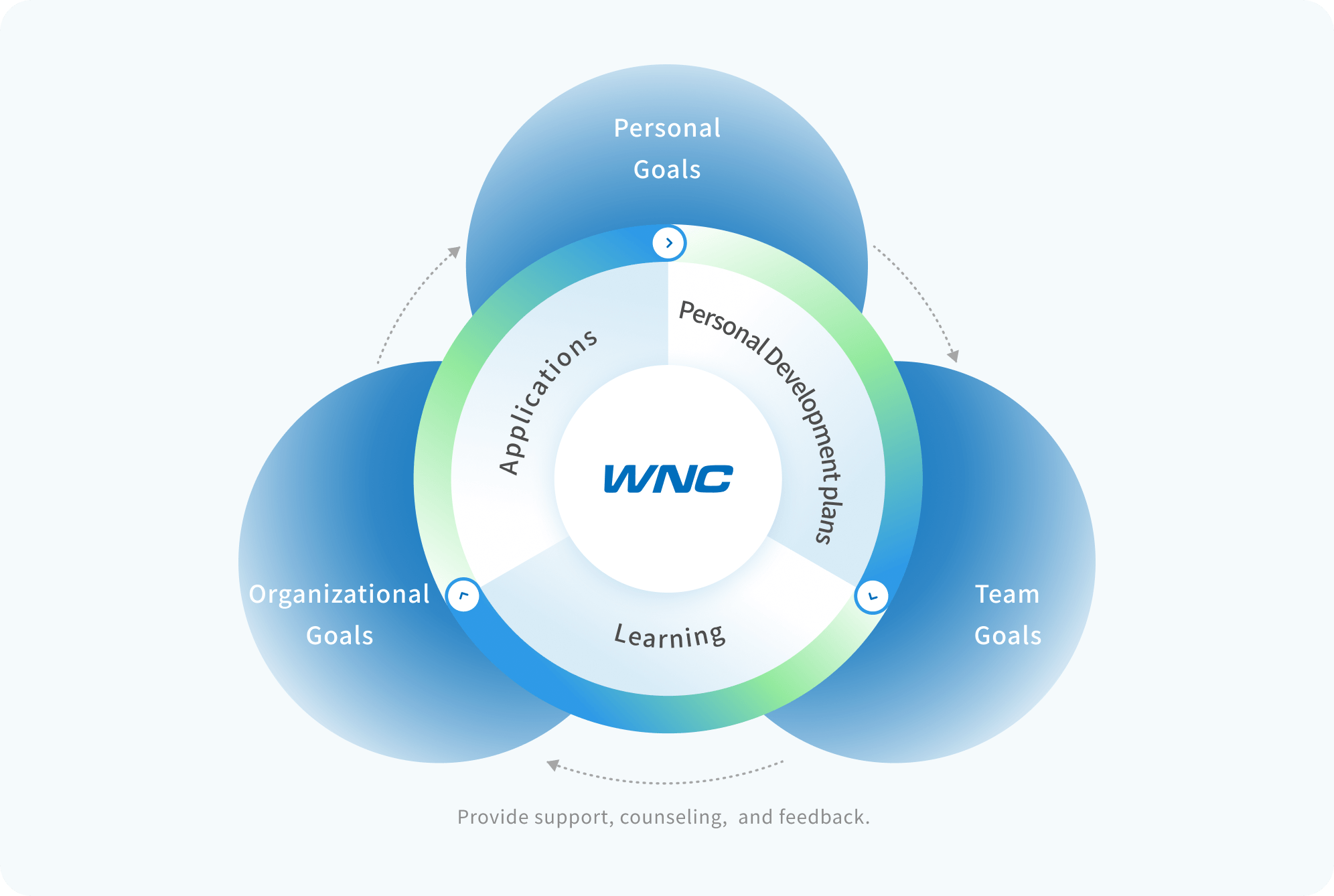
WNC employees and managers work together to formulate individual development plans and learning targets that integrate individual, team, and organizational goals. Through curriculum training, job rotation, guidance and feedback from supervisors, and goal-driven performance evaluations, WNC supports and fosters employees’ growth and development. At the same time, through annual organizational talent reviews and talent development meetings, WNC identifies outstanding employees who have demonstrated high potential to become future mid- and high-level managers, pinpoints gaps in organizational talent development, and identifies their development needs.
For high-potential, high-performance talents, skills evaluations and personal development planning are provided to combine organizational development goals and utilize multiple learning content and methods. These methods may include curriculum training, active learning, job rotation, project assignment, challenging task execution, and one-on-one coaching. These initiatives motivate employees and strengthen their abilities in various areas, helping WNC meet its talent needs and maintain operational stability during organizational expansion.
Career development
In accordance with WNC's Employee Promotion Management Regulations, permanent employees who have been in their positions for a requisite number of years, have exhibited the required skills and performance, and who are regarded as capable of taking on greater responsibilities are eligible for promotions. In 2025, rates of male and female employees accepting WNC career planning were 6.32% and 5.66% respectively.

Promotion management planning: Both DL and IDL employees adopt a dual-track system of both specialized and management positions to provide appropriate planning for employees.
Assessment of candidates for promotion: IDL employees are evaluated based on their experience and performance in their position, in order to assess their readiness for post-promotion responsibilities. The responsible supervisor and the Organization and Talent Development Committee performs assessment after the unit supervisor’s nomination. Regarding promotions for DL employees, after production line supervisors have considered work performance and taken organizational needs into consideration, DL employees may be promoted to production line leaders or transferred to positions with specialized work duties and be given raises or work allowances. Outstanding performers may also, in accordance with established procedures, be transferred to positions for IDL employees, such as assistant engineer, engineer, or function manager.
Career transition assistance
For WNC employees facing resignation, retirement, or career transitions, the company provides structured, transitional assistance. These initiatives help employees navigate changes smoothly, sustain their professional value, and maintain their quality of life. In 2026, WNC will systematically roll out formal career transition guidelines, reaffirming the company’s commitment to lifelong employee care.
Practice | Description |
|---|---|
| Retirement support | WNC's Taiwan sites have established regulations for employee retirement in accordance with the Labor Standards Act and the Labor Pension Act. These regulations cover eligibility requirements, payment standards, procedures used to apply for pensions, and the payment of pensions. For employees who are retiring, the HR department conducts personalized retirement interviews. Based on mutual agreement and internal assessments, the company may establish post-retirement consulting partnerships to ensure that these employees transition to retirement smoothly. |
| Support measures for career continuity and involuntary separations | When a manager finds that the work performance of an employee is not as expected, it is necessary to clarify whether there are other internal and external factors at play. If necessary, managers will cooperate with the HR Department to initiate a Performance Improvement Plan (PIP). They will work with the employee to set a clear improvement goal and establish action plans. Regular performance reviews and coaching interviews will be conducted within the period that the PIP is in effect. For employees whose contracts are terminated, the company provides severance pay in accordance with local labor laws. As transitional support, we also provide guidance on applying for unemployment benefits and accessing vocational training resources. |
| Internal talent mobility and transfer mechanism | Job vacancies are posted on WNC’s internal platform, allowing employees to apply as they see fit. The HR department then facilitates the process by matching resumes and scheduling interviews. Once the employee that applied for the job vacancy and the unit that posted the vacancy are willing to proceed, the transfer process is initiated, followed by subsequent tracking and follow-up. |
| Employee Assistance Program (EAP) | WNC's EAP partners with external professional consultants to offer diverse support services, including psychological counseling, career planning (for departures and retirement), and retirement financial advising. |